Operating Rate of Secondary Aluminum Producers Declined in October Amid Multiple Pressures, Slight Improvement Expected in November [SMM Analysis]

Published: Nov 11, 2025 19:07
Source: SMM
[SMM Analysis]Operating Rate of Secondary Aluminum Producers Declined in October Amid Multiple Pressures, Slight Improvement Expected in November

Survey Data on Operating Rates of Secondary Aluminum Alloy Enterprises by Region and Scale in October 2025:
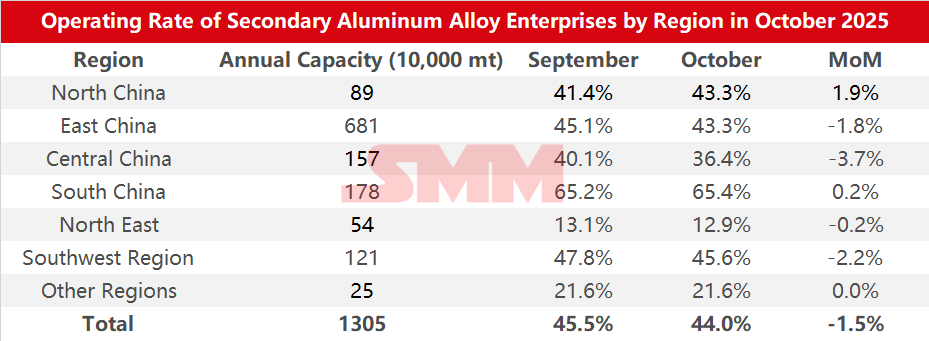
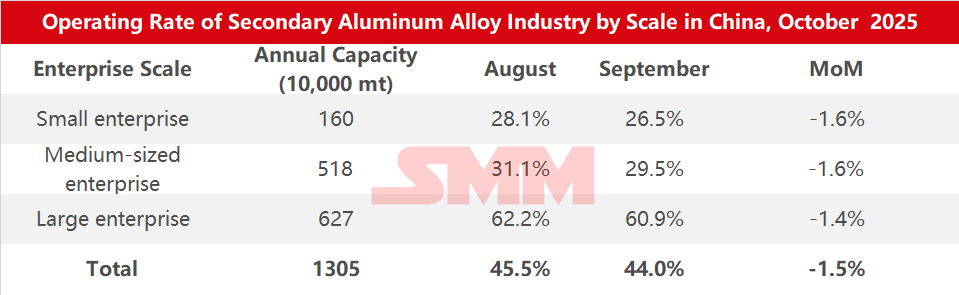
According to the SMM survey, the operating rate of the secondary aluminum industry in October 2025 fell 1.5 percentage points MoM to 44.0%, but rose 2.2 percentage points YoY.

In October, affected by multiple factors, the overall industry operating rate was under pressure. The main constraints included:
(1) Holiday shutdown impact: Aluminum liquid direct supply enterprises maintained continuous production, but mostly adopted shift systems and appropriately reduced load operations; some enterprises suspended production for about three days. The overlapping Mid-Autumn Festival and National Day holidays led to extended holidays for downstream enterprises, causing orders for secondary aluminum enterprises to contract MoM.
(2) Raw material supply gap: The tight supply of domestic aluminum scrap in October remained unchanged, with the difficulty of recycling aluminum tense scrap being particularly prominent. Meanwhile, limited supplementary supply from imported aluminum scrap due to persistent price inversions left enterprises facing procurement difficulties. Raw material inventories continued to be consumed, but restocking was hindered.
(3) Cost squeeze pressure: Affected by the continued tight supply of aluminum scrap, traders actively followed price increases, driving the cost per metric ton of aluminum scrap up sharply by 304 yuan MoM in October. Simultaneously, copper prices continued to hit record highs, coupled with rising silicon prices, squeezing the raw material costs for secondary aluminum plants. As cost increases were too rapid, the theoretical profit margin for the industry was compressed, even leading to losses, forcing enterprises to cut production.
(4) Policy disruptions: Some enterprises in Henan, Jiangxi, and other regions continued production cuts or suspensions due to uncertainty regarding tax rebate policies, focusing mainly on digesting finished product inventories, with production tending to be conservative.
(5) Impact of environmental protection-driven production restrictions: Environmental protection-related controls initiated at month-end in Hebei and other areas caused disruptions to local production and transportation, but the overall impact was controllable.

Entering November, as the holiday factor subsides and year-end demand for pushing annual targets is released in the end-use market, orders and operating rates for secondary aluminum plants are expected to receive phased support. However, the industry still faces multiple challenges: on one hand, raw material supply shortages, regional environmental protection-driven production restrictions, and policy uncertainties continue to hinder capacity release; on the other hand, the rapid rise in aluminum prices in November led to a significant decline in downstream purchase willingness, with insufficient momentum for rushing to buy amid continuous price rises, resulting in a contraction of secondary aluminum orders and further constraining the upside room for the operating rate. Overall, the industry's operating rate in November is expected to show a slight MoM improvement but appear weak YoY.
Data Source Statement: Except for publicly available information, all other data are processed by SMM based on publicly available information, market communication, and relying on SMM‘s internal database model. They are for reference only and do not constitute decision-making recommendations.

For any inquiries or to learn more information, please contact: lemonzhao@smm.cn
For more information on how to access our research reports, please contact:service.en@smm.cn
Related News
Fed Governor Milan Pushes for Over 100 Basis Points Cut, Contradicts Barkin on Caution
11 hours ago
Fed Governor Milan Pushes for Over 100 Basis Points Cut, Contradicts Barkin on Caution
Read More
Fed Governor Milan Pushes for Over 100 Basis Points Cut, Contradicts Barkin on Caution
Federal Reserve Governor Milan pointed out that it is necessary for the US Fed to cut interest rates by more than 100 basis points this year. At the same time, he is very much looking forward to the performance of Kevin Warsh as Fed Chairman. However, Richmond Fed President Barkin emphasized that monetary policy must remain cautious until inflation fully pulls back to the target level, thereby ensuring the stability of the labour market.
11 hours ago
Democratic Senators Demand Delay in Fed Nomination Amid Criminal Investigation
11 hours ago
Democratic Senators Demand Delay in Fed Nomination Amid Criminal Investigation
Read More
Democratic Senators Demand Delay in Fed Nomination Amid Criminal Investigation
All 11 Democratic members of the US Senate Banking Committee jointly sent a letter to the committee's chairman, Tim Scott, requesting that all nomination processes for the prospective Fed Chairman, Kevin Warsh, be postponed until the criminal investigation into current Fed Chairman Powell and other board members is concluded. However, Scott stated that Warsh's confirmation was a done deal.
11 hours ago
Fed to Keep Large Banks' Capital Levels Unchanged, Postpones Stress Test Reforms Until 2027
11 hours ago
Fed to Keep Large Banks' Capital Levels Unchanged, Postpones Stress Test Reforms Until 2027
Read More
Fed to Keep Large Banks' Capital Levels Unchanged, Postpones Stress Test Reforms Until 2027
The US Fed has announced that it will maintain the capital levels of large banks unchanged during the upcoming stress test cycle (corresponding to the 2026 cycle). At the same time, the US Fed is planning multidimensional reforms to this annual test, aiming to enhance its transparency. The US Fed's Vice Chair for Supervision, Bowman, revealed that adjustments to the stress capital buffer requirements for large banks will be postponed until 2027. This move is intended to provide the US Fed with sufficient time to evaluate potential flaws that may be exposed in its testing models when assessing banks' financial conditions under simulated economic downturn scenarios.
11 hours ago